NITROGEN TIRE INFLATION |
||||
NITROGEN ADVANTAGES By: Modern Tire Dealer No service elicits more positive and negative feedback from our readers than filling tires with nitrogen. Modern Tire Dealer has written on the subject for decades, yet nitrogen still has its detractors. Back in 1967, our November cover featured Gulf Oil Co.’s attempt to test market nitrogen inflation at 41 of its stores in Houston, Texas. Its supplier, Big Three Industrial Gas & Equipment Co., charged $6.75 for a 300-cubic-foot bottle of nitrogen. Gulf Oil charged its customers $1 per tire. And how can we forget the “nitrogen tire car” that was displayed at the NTDRA trade show in 1996? The car was driven 33,000 miles through 15 countries from Brazil to the United States (though when one of the tires had a blowout, it was replaced with one filled with air) Not until July 2004, however, did we start to look at the possibility of nitrogen fill becoming a mainstream automotive service. Since then, we’ve written at least one story a year on the topic. We have approached it from every conceivable angle, from why it works to how it is marketed. Nitrogen people, tire dealers and, yes, even we have made many claims in those stories. Our most recent anti-nitrogen e-mailer simply said we have failed to present both sides of this issue. Today, nearly one third of independent tire dealers offer nitrogen. In our “2008 Nitrogen Inflation Service Survey,” 89.2% reported they charge at least $1 per passenger tire for the service; 80% charge $5 or more per tire. For light truck tires, 94% of the dealers charge at least $1 per tire, and 80.1% charge at least $5. Tire Discounters Inc., the 14th largest independent tire dealer in the United States, only offers nitrogen as a tire fill. So, are the claims we have written about valid, or are we in for claims adjustments? Are we following our Mission Statement, which requires us to help you run your businesses more profitably? Here’s a time line of a representative sample of MTD’s stories, what was said, and if the claims were justified. July 2004: “Nitrogen: no, niche or now?” The use of nitrogen instead of compressed air was being considered by some “pretty heavy hitters” at the time, including Dunn Tire LLC, Conrad’s Total Car Care & Tire Centers and the Zurcher Group. Tire Discounters and Costco Wholesale already were on board. “Time will tell if it’s a fad, but there are a lot of pluses in nitrogen’s favor — and few minuses,” we wrote. A University of Bologna study concluded that tires inflated with nitrogen lose pressure at a slower rate than a tire inflated with air, 1.6% over the course of a month versus 3%. According to the results of a 12-month test of H- and V-rated all-season tires conducted by Consumer Reports, tires filled with 95% nitrogen lose psi at a slower rate than tires filled with air. Over a 12-month period, the average loss in the nitrogen-filled tires was 2.2 psi, compared to 3.5 psi for the air-filled tires. (In the Consumer Reports test, the tires were placed outdoors; an engineer told us that everything being equal, the rate of loss in stand-alone tire and wheel packages versus tires in use would be about the same.) CLAIM: Nitrogen drastically reduces oxidation on the rim and inner-liner because oxygen is almost totally eliminated from the mix. This is true. Air is made up of about 78% nitrogen, 21% oxygen and 1% argon and other inert gases. The more oxygen you replace with nitrogen, the less oxidation. Less oxidation and moisture helps the tire last longer. “If you maintain air pressure all the time, the benefits of nitrogen diminish,” said Clark. “But the average customer doesn’t do that.” Of the more than 5,500 vehicle tire pressures checked by the Rubber Manufacturers Association (RMA) as part of its “2009 Tire Pressure Survey,” 91% had at least one improperly inflated tire, and 19% had at least one tire under-inflated by 8 psi. |
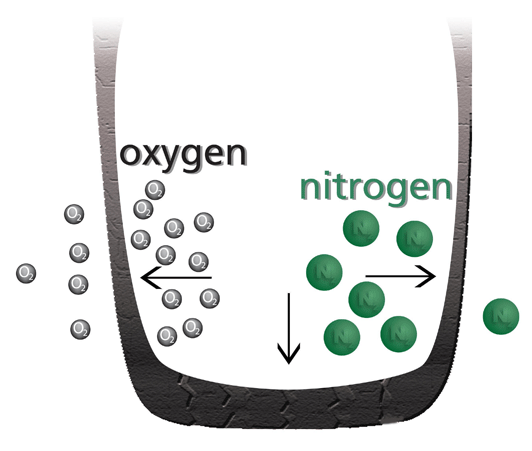 The use of nitrogen is not a replacement for regularly checking tire pressure, and all nitrogen suppliers readily admit that. However, it is not realistic to believe that the majority of car owners will change their driving habits anytime soon, given RMA research. If a nitrogen generator fills a tire with, say, 95% nitrogen, that doesn’t mean it has 95% nitrogen in it when the desired psi is reached. Even when flat, the tire contains air. For a 95% concentration of nitrogen, it typically takes two purges at a higher concentration. What purity level will give you the benefits of nitrogen? Industry participants are still debating that issue. The Get Nitrogen Institute (www.getnitrogen.org) says 93% nitrogen in the serviced tire is enough to gain the benefits of nitrogen inflation. Others put the minimum at 95%. One engineer with whom we talked said it has to be 99% pure or the benefits will be minimal at best. A study by Ford Motor Co. found that the use of a high purity level of nitrogen in tires can “significantly” slow down or even halt tire aging compared to air-filled tires. In “Effects of Nitrogen Inflation on Tire Aging and Performance,” authors John Baldwin, David Bauer and Kevin Ellwood tested tires filled with air, 96% nitrogen and 99.9% nitrogen. They wrote that the performance results at 96% were not substantially different than at 99.9%. “This is important for the average consumer because the need to purge existing tires completely of air before filling with nitrogen may not be necessary,” they concluded. |
 .CLAIM: “Properties of nitrogen minimize deterioration of rubber and tire cords.” If the purity of nitrogen in the tire is high enough, yes. In the Ford study, the authors concluded that “the oxidation of the steel-belt rubber is truly driven from the contained air pressure inside a normal passenger or light truck tire.” May 2008: “Inflation proclamation.” The story addressed how to let your customers know you offer nitrogen, and how to convince them to pay for it. It “is not going to sell itself,’ said Terry McCune, Big O Tires Inc. in Livermore, Calif. The key was being relentless in informing his customers that he offered the service. Average cost of gas/gallon: $3.60 Average miles per gallon: 20 The average fuel savings by using nitrogen, all things being equal, is about 3.3%, according to the Get Nitrogen Institute, www.fueleconomy.gov and a Canadian study of trucking fleets conducted by a nitrogen tire inflation equipment supplier. The U.S. Department of Energy and U.S. Environmental Protection Agency estimates that for every 1 psi drop in tire pressure, there is a 0.3% drop in gas mileage. The degree of benefit to the consumer depends on the percentage of nitrogen in the tire (remember, the existing air in the tire will dilute any concentration of nitrogen pumped into it), but there are a lot of measurable benefits. A tire that remains properly inflated longer deflects less than an under-inflated tire, which helps it run cooler, wear evenly and roll more freely. The result is increased tire life and improved fuel economy. In addition, less oxygen leads to less oxidation and moisture. That, in turn, helps reduce wheel corrosion and tire structural integrity degradation. ■   |
||
